



Skyrim is one of the most mod-prone games of the past decade. Everything from Spider-Man costumes, Thomas the Tank Engine costumes, machine guns and nudity mods abound. And now, a kissing mod, Not the first, in fact. But this one is interesting because it does not employ custom animations. Instead, it uses some ridiculous tweak to the ragdoll systems which results in characters making preposterously dramatic lunges at one another, during which mouths may or may not connect.
This is (tenuously) relevant, because what we have here is not so much a kissing gesture, as much as a weird jumping-like motion that has been repurposed and packaged as ‘kissing’, and which we accept as such, partly because the movements are vaguely familiar and partly because the modder tells us to. The kissing is implied rather than executed, which is to the consumer the same as being executed. It was not kissing but now it is.
What role does an existing relationship between players play inside a game?
There are some slightly regrettable elements to this question. What ‘role’, is hardly specific. An ‘existing relationship’ is in sore need of some specific definition. On the whole, the question seems oddly specific and wildly vague at the same time, and I’m a loss why I thought this was an adequate question only a week ago.
Regardless, let’s have a stab at half an answer. I think we can establish that pre-existing relationships do play a role in how a game is experienced by two said involved specimens in said relationship. Otherwise, friends would probably not play games together. But they do. And their friendship is a key motivator. They would rather play with a friend than with a stranger. Which is understandable. That’s what friends generally are for.
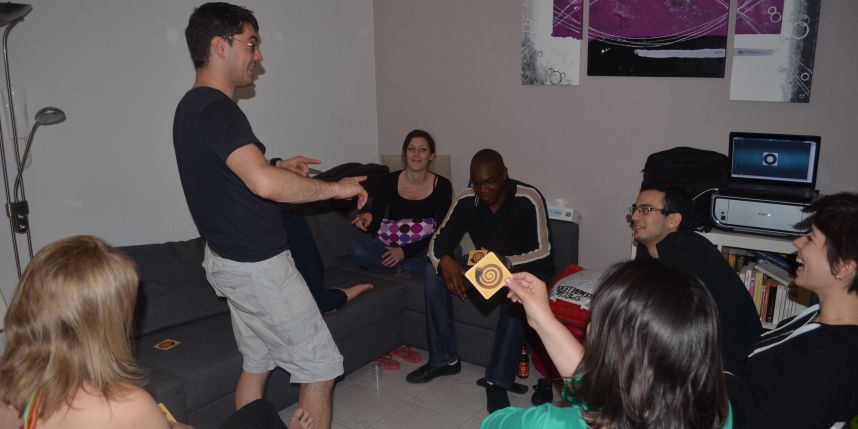
However, the game that is to result out of these findings presupposes a measure of dramatic interaction. Familiar and amicable interaction more or less precludes any dependably dramatic interaction. So should the players always be total strangers and unaware of true identities, like in Journey? Or can their be some mechanic, some transformative element that makes it easier to relinquish existing roles and assume new ones? In Les Loups-Garou de Thiercelieux, players easily cast off existing roles and relationships to assume new ones to the benefit of the game, but a case can still be made that pre-existing relationships influence their decisions inside the game.
Further research is required to make any sort of definitive statement about this quandary. The best course of action, I think, is to organize a few playthroughs of Les Loups-Garou de Thiercelieux and other games that involve some form of roleplaying, and see how this affects familiar dynamics.
On to the second sub-question:
What does ‘drama’ entail within a game?

What does drama entail at all? The word derives from the Greek word δρᾶμα, which means action. It derives from the verbs to do or to act. Which seems to imply that in drama, things happen. Further glances tell us that “The enactment of drama in theatre, performed by actors on a stage before an audience, presupposes collaborative modes of production and a collective form of reception.”
That’s all very well. Drama is something where things are made to happen in a collaborative effort to be consumed or spectated in a collective fashion. And that’s just dramatic theatre. Would I would like to do in this article is attempt to distill which active elements within ‘drama’, whether it be theatrical, cinematic or something else, are present in video games, which aren’t, and which of those that aren’t could conceivably be transposed into a video game context that realize the sort of advanced puppetry I’m currently envisioning as the end result of this project.
As mentioned previously, a lot of definitions mention, in some form or other, ‘collaborative modes of production’. In a lot of cases this refers to the gesamtkünstlicher nature of theatrical productions, and the ensemble of creators necessary to facilitate it. The writer, the performers, set designers, builders, a small army is required to play out the drama contained in a play. Similarly, we can steal the definition and hereby propose ‘collaborative modes of production’ could also refer to players. A multiplayer game is nothing if not a collaborative mode of production, the production being the final, unique experience of gameplay, the mode being the actual play, and the collaboration the very fact that two or more players are interacting with one another in a designated arena.
But can we say that presence of X systems guarantee a Y amount of drama? How much is 1 drama? Can you have too much drama?
The problem is that, much like improvised drama, most significant interaction will take place between players, who are, contrary to the system, complete mechanical unknowns. There is no sure way of predicting the totality of player actions, which is at once what makes it beautiful, but hard to encapsulate from a designers’ standpoint. This means that there is no true guarantee of a coherent story or even something that is interesting. Somehow, the means available to the players must be constrained to simultaneously imply a sufficiently large range of expression, as well as conducive limit that challenges them to reach beyond what is offered and start to create situations themselves.
When a player kills another in a game it is a nuisance for the receiving party. But it is not necessarily dramatic. If the two players concerned were on the same team, and this killing was in fact dramatic, this contextualizes it as dramatic, but as long as this is not sufficiently backed by the players’ performance, it is simply tomfoolery. So, how can the environment and the programming aid in contextualizing players’ actions as those of a dramatic nature?
I like Ralph Bakshi. It stems partly from the medieval times in which I purported to be an animator, but I suspect the reason is more all-encompassing. The man is, like a lot of people I pointlessly prop up as effigies as if they reflected somehow on me, impractical in many ways. He tried to film The Lord of the Rings on a preposterously small budget. He tried to transpose Frank Frazetta’s art into moving pictures. He tried to introduce graphic sex and violence to animation. A lot of these impractical ambitions he realized through brazenly dealing or not dealing with people and not listening a lot to advice. A lot of his projects failed, but they are not necessarily failures.
In this video he has some choice advise for current creators, and the wealth of options they (including me) regularly fail to see. By disingenuously placing this on my blog, I hope some of it rubs off on me.
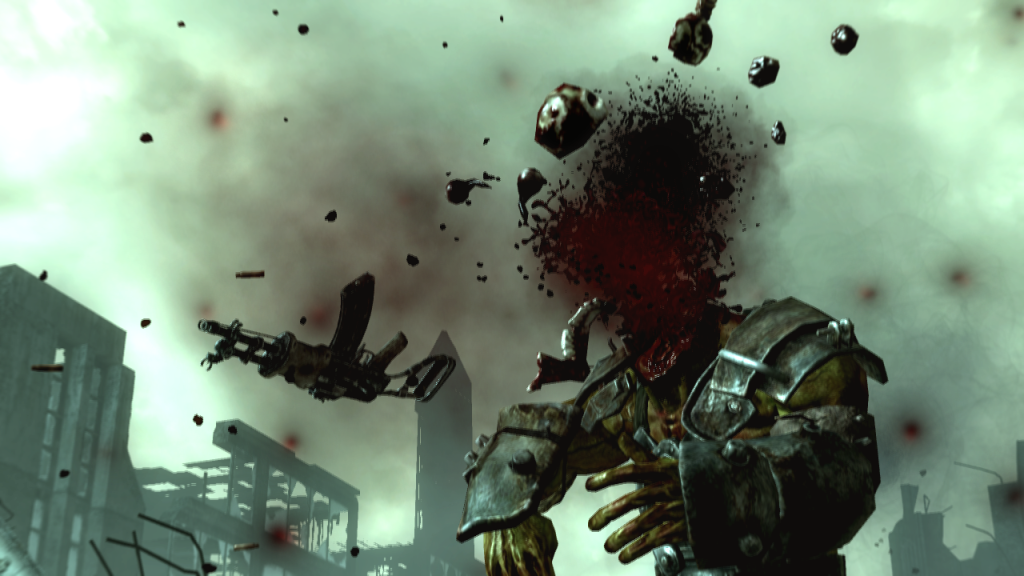
Shooting things with a shooty thing mounted in the middle of your screen is perhaps one of the most pervading and immediately recognizable images of modern gaming. The first-person shooter has been a fixture since Doom, and although it can be argued that its zenith days may be over, it is still easily one of the most popular means of killing people on the computer.
However, even in these seemingly base games there can still be found the seeds of a dramatic performance not warranted but sprouted by both the game’s internal workings and a developed culture between the players. Most evident (and probably most familiar to involved players) is the concept of Teabagging, a low-brow debasement of an unrelated mechanic which, on closer inspection, is actually an ember of culture within a digital framework.
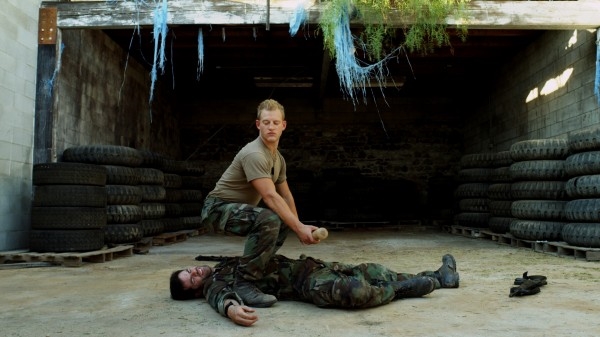
Teabagging is what happens when Person A shoots Person B dead, after which Person A repeatedly crouches on top of Person B’s lifeless head, implying that he is pushing his scrotum into his vanquished foe’s face. While in essence a base form of ritualized humiliation, the very fact that the crouch button – usually used for crouching – has transcended from a tactical control to a human expression, however dubious, is an interesting and encouraging one. The game lacks a visual language, so the players inhabiting it develop one, repurposing existing movements and reestablishing them as conveyors of information, of emotion even. However base. This type of unassisted dialect creation is something that I’d like to emulate in Exit Pursued By A Bear.
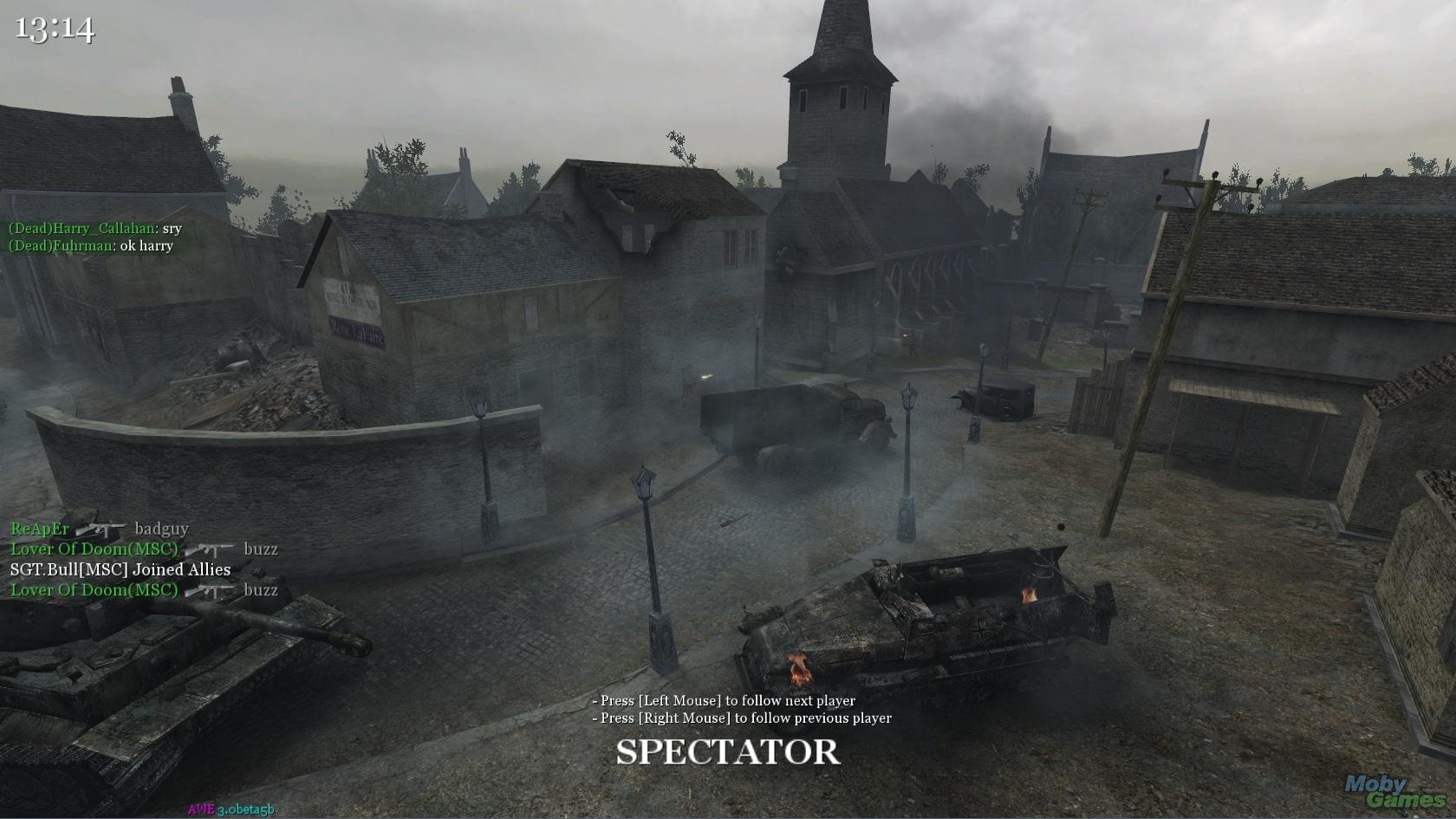
The second element of first-person shooters I wanted to touch on is Spectator Mode, a feature of many multiplayer modes. The concept is simple. When you die, you usually have to wait for a bit, either until the end of the match or until a respawn timer or some such mechanic has run its course. Many games offer the use of a Spectator Mode to use in these types of situations, or sometimes have dedicated Spectator Modes for entire sessions.
It basically does what it says on the tin – rather than actively participating in the game, you are a spectator, often having a choice between fixed camera angles and piggybacking on the players’ perspectives, an objective overview and a subjective angle; all boiling down to the same thing: Suddenly, the game has an audience. The game played is not just for the benefit of the involved players, but also caters to an invisible audience of onlookers.
Now, in an era where both Twitch-streaming and Youtube Let’s Plays have become staples and fixtures, this may not sound overly interesting. It might, in fact, even sound outdated. It is. Twitch presents a far more direct way of letting spectators in on your games and Youtube allows far more channels of communication between players and audience; but Spectator Mode is an embedded function inside a game. The audience is, to an extent, there, not merely watching the players’ screens, but inhabiting the game space, invisible, yet still in control of their own movements and perspectives. They have a choice what to view and how to view it, a choice that they must make as the game is being played, not before or after. Even though they are spectating, they are in effect also playing.
It is this ‘involved audience’ mechanic that I would like to capitalize on in this project. A performance-centered game by definition appears to need someone to witness it to qualify as something to do with performance, and I would prefer it be to the benefit of more people than merely the players. What play is only to the benefit of actors. Except, perhaps, Larps. More on that later.
As discussed previously, one of the sub-questions currently under observation is
- How can a system induce without compelling?
If this video game is supposed to encourage but not enforce dramatic inter-player interaction, there must exist sustained stimuli to make them do so. However, their dramatic contributions should be drawn from imagination and creativity rather than dutifully rendered to comply with some preordained objective. Paradoxically, the problem spells out something along the lines of “Players must do X but they mustn’t feel like they have to X but they need to do it anyway.”
Earlier I analysed the narrative device known as the MacGuffin, which is an object er event that propels characters through a narrative without having very much meaning in and of itself. Translated to the video game grammar, this would mean an obvious, concrete objective to reach within the confines of the game, that is not as essential as it initially seems.
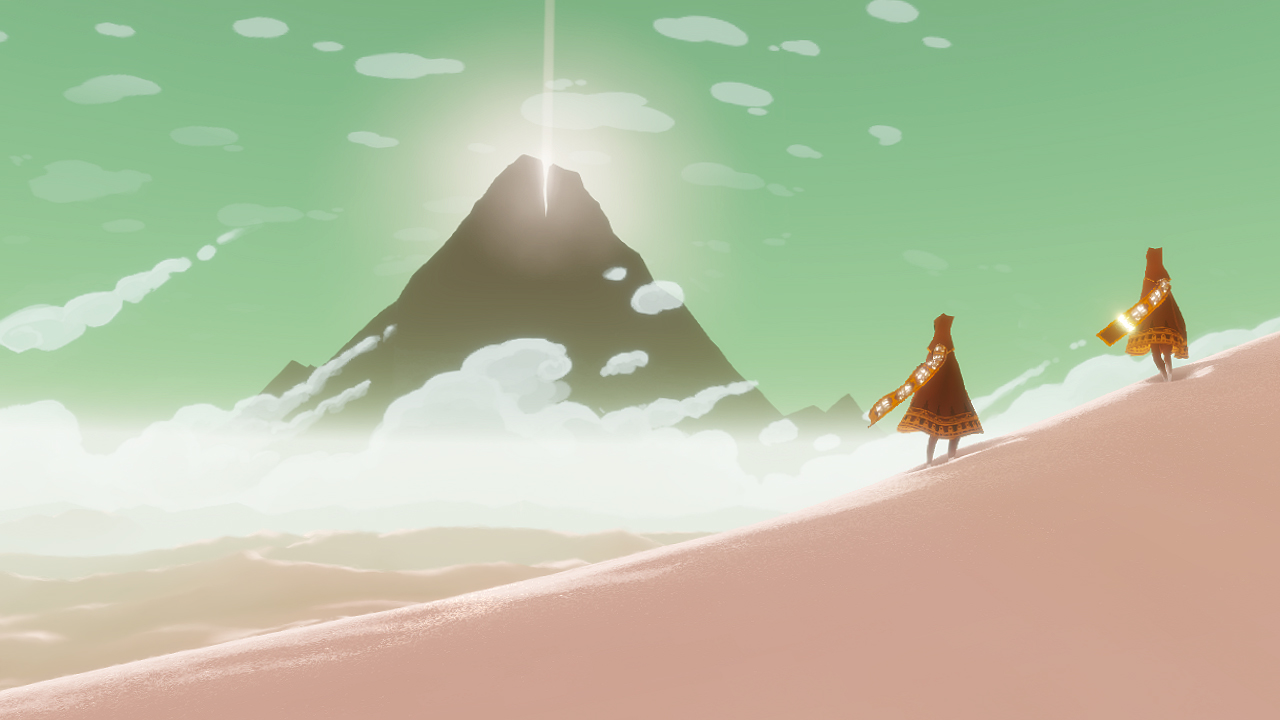
Journey appeared to be about journeying to the mountain. It involved journeying to the mountain, and ended with you ending up said mountain. The game, however, was not about the mountain. The featured some light platforming and collecting stuff, but it wasn’t really about that either. It was about the subtle, anonymous multiplayer mechanic, where though limited communication two players, unaware of each other’s identity and with no way to discover it before finishing the game, forged a relationship between the two players, companionship for the titular journey. A game that solely dealt with this would be much harder to realize without the huge mountain-shaped MacGuffin (though the idea is not without merit), but within the confines of the concept, it works very well, as the objective-driven mind of the player is still concerned with reaching the mountain, even if he spends more time interacting than actually completing this goal.
On the other hand, if I really want meaningful, dramatic interaction in my game, it can’t solely rely on misdirection and subtle induction. The meaningful interaction would probably entail concerted effort from the players’ side, a will and a want to perform and interact with one another, something that is not featured in Journey. The interaction can’t just be incidental, a byproduct of more focused play. Therefore, we can conclude that the ‘MacGuffin’ in the game, the device that will induce players into performance, can’t be an all-encompassing, direct objective like a gargantuan mountain in the distance. Which begs the next question: Of what nature should the MacGuffin be in order to realize the goal of meaningful inter-player interaction? In any case:
Tenet: The performance-inducing MacGuffin cannot supersede the performance-focused goals of the game.
It might be a Scottish name, taken from a story about two men on a train. One man says, “What’s that package up there in the baggage rack?” And the other answers, “Oh, that’s a MacGuffin”. The first one asks, “What’s a MacGuffin?” “Well,” the other man says, “it’s an apparatus for trapping lions in the Scottish Highlands.” The first man says, “But there are no lions in the Scottish Highlands,” and the other one answers, “Well then, that’s no MacGuffin!” So you see that a MacGuffin is actually nothing at all.
Alfred Hitchcock popularized but did not invent the MacGuffin. The plot device predates its term. A MacGuffin is an object or element in a narrative that impels the characters to progress through the plot, while usually having very little or value in and of itself. The MacGuffin seems relevant, but its actual worth is often negligible. Like the titular Maltese Falcon. Like Rosebud in Citizen Kane. They motivate change but they do not offer any outcome.
This device may translate well to the sort of performance-driven ‘game’ I’m trying to coax into workable form. For players to interact in any meaningful dramatic form, some relevant, or seemingly relevant motivator is required. Any playthrough of any game might have been dramatically interesting if this weren’t the case. Assuming for now that it isn’t, the MacGuffin might be a mountain in the distance. It might be a crumbling bridge. More relevantly, it was the boat in the distance in my own game, Raft. You were never meant to reach the boat, but it impelled-first time players to use their performance controls, like panicked waving. And thereby laid the ground rules for inter-player performance.

It seems like, at least until testing proves otherwise, that this sort of approach is warranted to transport players from objective-minded play to dramatic-minded play. That is the assumption, for now, at least.
Tenet: A game-related MacGuffin Objective is necessary to induce players into a dramatic performance.
Remove everything that has no relevance to the story. If you say in the first chapter that there is a rifle hanging on the wall, in the second or third chapter it absolutely must go off. If it’s not going to be fired, it shouldn’t be hanging there.
Chekhov’s Gun is a dramatic principle formulated by the playwright Anton Chekhov. Roughly speaking, it dictates that all elements presented in a dramatic framework must also be used within said dramatic framework. If something is not utilized, it is pointless and can therefore be omitted. Every present element becomes necessary and irreplaceable. Any piece of puzzle inevitably foreshadows a future event.
Though interesting and potentially useful, the principle does not translate well to mechanic. Video games implicitly feature choice, however little, down to choosing whether you play the game at all or not. Barring explicit railroading, there is no real way to force a player to use a certain object in a certain way, not if the object of a game is to allow expression rather than convey orders.
The principle can, however, be bastardized into useful form. Leaving aside for the moment the imperative of actually using an object, the very presence and possibility of using an object can add to the character and possible execution of a scene. Slathering a scene with weaponry adds violence and threat to a scene even if they are not used. Whether this still qualifies as actual use of Chekhov’s Gun is doubtful. The necessity of use appears to be paramount, so, by definition, it would appear that it cannot work well within an interactive environment.
Now that we have excised the previous limp attempt at a thesis, let’s take a pot shot at a new one. Bearing in mind the previous criticisms of my initial proposal and the insights that came with the ‘puppetry’ definition, this:
“How can I induce players to interact dramatically with one another inside a virtual space?”
This one seems to cover most, if not all objectives I had vaguely formulated inside my head. The sentence assumes players don’t usually interact dramatically with one another inside most video games, playing usually as themselves or from the comfortable distance that the character they control is not really them. This is a sweeping and slightly bent statement, but thus far my research has not found a game that explicitly features dramatic interaction as a key feature, so we’ll let that be for the moment.
‘Dramatically’. What does it mean in this context. Can general correspondence not be dramatic? It probably can. But explicitly, intentionally so? Probably not, but this has to be substantiated and the term has to be more well-defined within the context of the project.
‘Virtual space’. For now, we’ll define this as ‘within the confines of the program that will result from this research’.
‘Induce’. It’s not as strong a word as ‘compel’ or ‘force’, but still, it suggests external guidance by either design or a directer influence, like another player. Is this necessary? Probably, otherwise there would be far more games featuring intrinsic performance.
‘One another’. What does the existing relationship between players mean for the relationship they establish through their characters. More importantly, can this be reliably synthesized and implemented inside a game?
From this short analysis, I believe we can glean the following sub-questions:
Undoubtedly I am forgetting something here, but now it’s regarded for posterity, and more importantly, future me. I will now set about filleting these questions until I can produce a more pure, accurate form.

 Ernst-Jan van Melle | Body of Work